
Manufacturing

Oregon wood is used to make a wide range of products, generating income and employment for many rural communities.
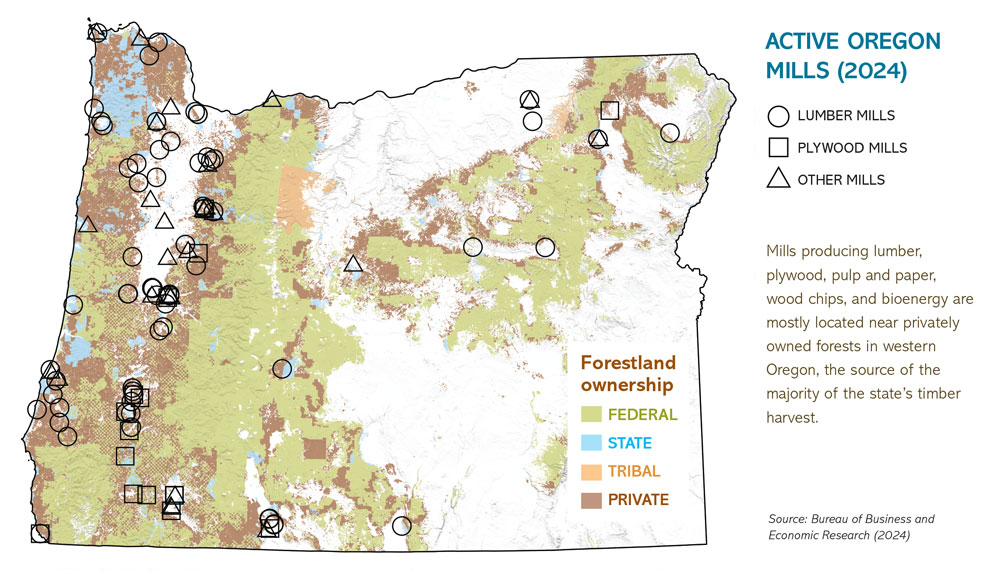
Timber sourced from Oregon’s forests is used to make a wide range of products, including lumber, plywood and veneer, pulp and paper, and bioenergy, generating income and employment in many of the state’s rural communities.
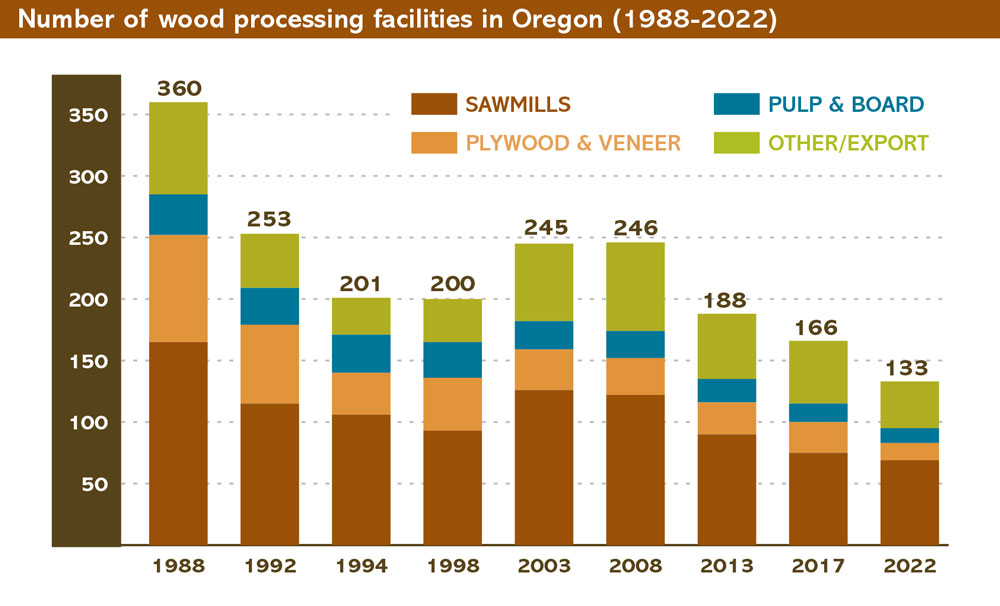
Although the number of lumber mills in Oregon declined by 58% between 1988 and 2022, and by 45% between 2003 and 2022, this trend does not necessarily indicate a shrinking industry. The reduction can be partly attributed to improvements in mill efficiency, shifts in timber supply and industry concentration.
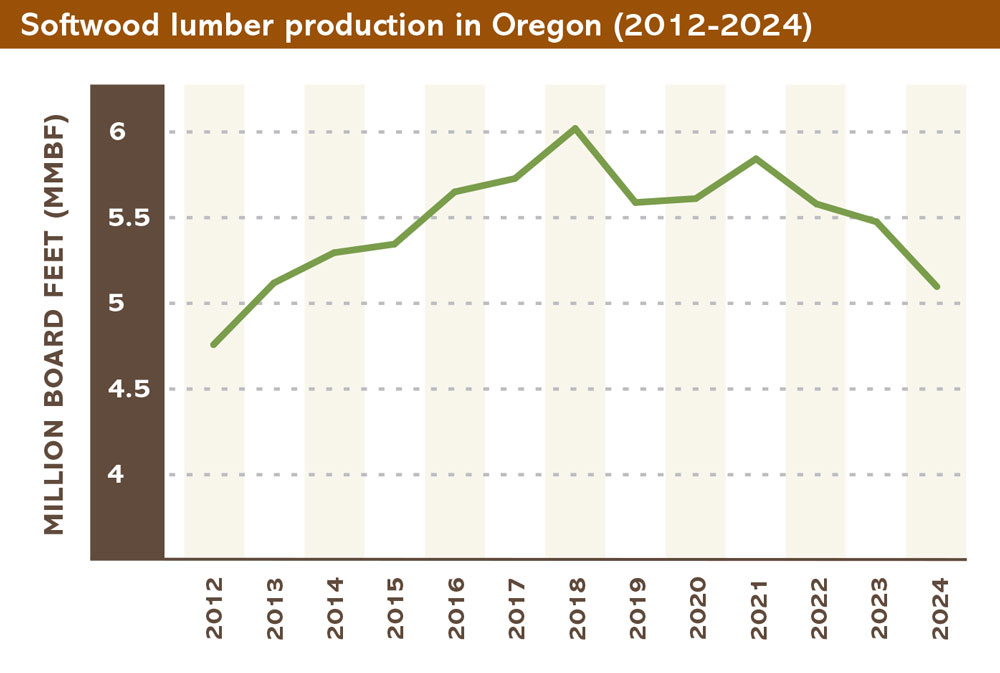
As it has been for years, Oregon remains the top U.S. producer of softwood lumber and plywood. In 2024, Oregon sawmills produced over 5 billion board feet of lumber, accounting for approximately 14% of total U.S. production, while Oregon plywood mills accounted for about 28% of total U.S. plywood production in 2023.
How Oregon timber is used (2022)
• 69% delivered as sawlogs to sawmills
• 16% delivered as veneer logs to veneer and plywood plants
• 4% delivered to export facilities
• 10% chipped for pulp mills and board plants
• 1% delivered as other timber products to various facilities
In 2022, Oregon’s timber harvest totaled 3.7 billion board feet, a 5% decrease compared to 2017. About 91% of that timber came from counties west of the Cascade Range. Nearly 90% of logs are delivered to sawmills or veneer and plywood plants or are exported.
Research helps advance Oregon’s mass timber manufacturing
Public sector support for mass timber product research and development has helped Oregon forest products companies expand into mass timber manufacturing.
The Oregon Mass Timber Coalition, a partnership initiated in 2020 between Oregon State University, the University of Oregon, Port of Portland and several state agencies, is focused on enhancing and expanding Oregon’s established mass timber industry ecosystem and growing it into a significant regional cluster. These efforts include an industry-led research consortium with 22 member companies representing the state’s mass timber supply chain.
Anchoring these efforts is the work of the TallWood Design Institute (TDI), a partnership between Oregon State University’s College of Forestry and College of Engineering and the College of Design at University of Oregon. Established in 2014, it is one of the nation’s first interdisciplinary research collaboratives focused exclusively on the advancement of mass timber and other wood products building solutions.
TDI oversees a wide range of testing and applied research led by faculty from both universities in collaboration with public agencies and industry stakeholders while providing educational opportunities for a growing mass timber workforce.
A key element of TDI is the A.A. “Red” Emmerson Advanced Wood Products Laboratory on the Oregon State University campus. The Emmerson Lab is an engineering facility dedicated to applied research in advanced timber fabrication and structural performance of large timber buildings, including large-scale structural testing and advanced manufacturing.
In December 2025, Oregon State University broke ground on the Oregon Fire Testing Facility, due to be completed in December 2026. This facility will have the capacity to fire- test innovative wood products, enabling research in all aspects of mass timber production and use.
To learn more about TDI, go to tallwoodinstitute.org.